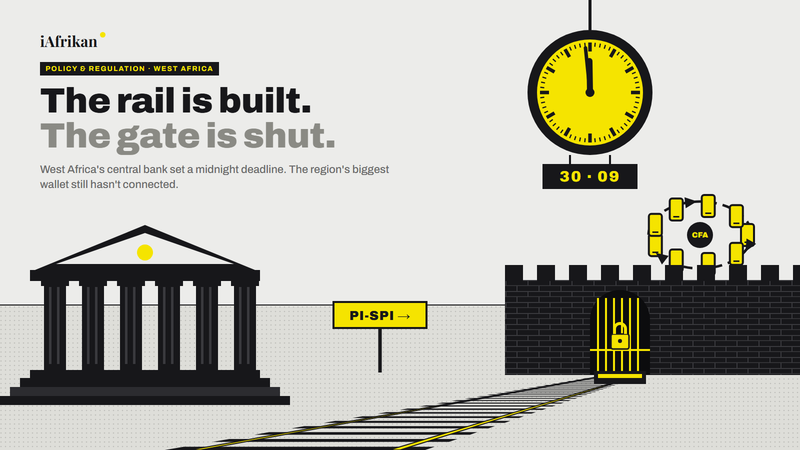
At midnight on 30 September, every bank and e-money issuer in eight West African countries is supposed to be plugged into the BCEAO's instant payment rail. The biggest fintech in the region still isn't. What happens next will tell African founders and investors more about how fintech markets get made than any funding round this year.
The Plateforme Interopérable du Système de Paiement Instantané, PI-SPI for short, is an instant payment switch built and run by the Central Bank of West African States (BCEAO). It serves the eight countries of the West African Economic and Monetary Union (WAEMU), Senegal, Côte d'Ivoire, Mali, Burkina Faso, Niger, Benin, Togo and Guinea-Bissau. It launched on 30 September 2025. Its promise is that anyone can send money instantly, at any hour, from any bank account or mobile wallet to any other, whoever the provider, and, in the BCEAO's own words, "securely and free of charge for individuals." The central bank calls it "a genuine public good." Think of it as the region's attempt at what UPI did for India and Pix did for Brazil.
In April, the BCEAO told every bank, e-money issuer and payment institution in the union to be connected and actually serving customers through PI-SPI by 30 June 2026. On 25 June, five days before the cutoff, it blinked. It moved the deadline for banks, e-money issuers and payment institutions to 30 September, and gave microfinance institutions until 30 June 2027.
By early April, 80 institutions had connected, 59 banks, 9 e-money institutions, 11 microfinance institutions and one payment establishment, with another 42 in live testing. Senegal led with 24 integrated participants by late July, Côte d'Ivoire had 23 and Mali 14. On 20 July, the BCEAO reported 30 million connected users and one million transactions worth 110 billion CFA francs, about $190 million, since launch. Orange Money is connected.
Wave is not!
The number that explains everything
To see why Wave's absence matters so much, put PI-SPI's first ten months next to the market it is meant to serve.
In 2024, mobile money in the WAEMU handled around 11 billion transactions worth about 160,415 billion CFA francs, roughly $267 billion. That is 119% of the union's combined GDP. The average day saw about 33 million transactions. Côte d'Ivoire and Senegal together accounted for around 65% of that value.
PI-SPI's $190 million in ten months is less than a tenth of one percent of what mobile money moved in a single year. The public rail exists, it works, and most of the region's money still doesn't use it. That money flows inside a few private networks, and one of them has grown faster than anyone else's.
Wave's share of mobile money transaction value rose from 34.0% in 2023 to 38.2% in 2024. Orange Money slipped from 43.3% to 41.3%, and MTN MoMo from 16.3% to 11.7%. Wave, with more than 20 million customers, is within striking distance of becoming the region's largest mobile money operator by value. It built that position the way Silicon Valley taught a generation of founders, a closed loop, low fees, and a product so simple that customers never needed to leave it.
Joining PI-SPI means opening that loop. A customer who can send money free and instantly from any wallet to any other has less reason to stay with one provider. Wave's six years of network effects become, in part, the central bank's network effects.
The real prize isn't transfers. It's keeping money digital.
It would be easy to read all this as a fight over transfer fees. The more important numbers are the ones about what happens to money after it lands in a wallet.
By the end of 2024, 248 million mobile money accounts had been opened across the WAEMU, but only 31% had been active in the previous 90 days. The region's "digital retention" figure is stark. Only about 7.5% of the value deposited into mobile money stayed in digital form. The other 92.5% was withdrawn as cash. The average transfer fell 9% to around 18,220 CFA francs, about $30. Registered merchant acceptance points doubled from 1.75 million to 3.7 million in a year, but most West Africans still use mobile money as a pipe between two piles of cash rather than as a place to keep and spend money.
This is where interoperability matters. If a trader in Bamako paid through one wallet and cannot pay a supplier in Lomé who uses another, the rational move is to cash out and carry notes. If any wallet can pay any account instantly and free of charge, that reason to cash out disappears. The providers' fee models reflect the stakes. Orange Money has moved from charging for transfers to charging a 1% withdrawal fee, capped at 5,000 CFA francs. Cash-out is where the money is made.
So the question behind PI-SPI isn't only who moves the money. It is whether the region's money stays digital long enough to build savings, credit and merchant economies on top of it. That is the prize the central bank is chasing, and a closed loop, however well designed, can only deliver it for its own customers.
The Wave question
Wave has not publicly refused to join. It simply hasn't appeared on the participant list, nine months and then twelve months after launch. There is a plausible route in. Wave's new Ivorian banking entity, Wave Bank Africa, could connect as a bank, which would give it direct access to the rail on terms it has more control over.
Some regional analysts read the June extension as proof of where leverage sits. One widely shared analysis put it bluntly: the BCEAO needs Wave's user base for PI-SPI to be viable far more than Wave needs the BCEAO's rail. A public switch without the region's fastest growing wallet is a switch between banks and the incumbents Wave is already beating. Tomorrow's deadline is the moment that theory gets tested.
The bit nobody adds in the news release: licensing.
PI-SPI is only half the story. The other half is the BCEAO's licensing overhaul for payment service providers under Instruction No. 001-01-2024, designed to bring the region's fintechs up to international standards.
Its deadlines have also slipped, from 1 May 2025 to 31 August 2025 and beyond. "After nearly a year and a half, we don't even have a dozen approvals," Eric-Franklin Tavares, founder of Paylican, told Launch Base Africa in August. Mohamed Thiam, co-founder of Socium, said simply: "We've seen investor confidence take a hit."
The funding data backs them up. Only around 12 deals were publicly disclosed across all eight WAEMU countries in 2026 so far, about five of them in fintech and mostly small. The largest, GoCab's $45 million, was structured with $30 million of debt secured against vehicles. Gozem's $24.5 million came from the IFC, with debt and quasi-equity favoured. One regional investor summed up the mood: investors are "avoiding equity risk in WAEMU fintech because the regulatory environment is unpredictable."
That is the real cost of moving goalposts. It isn't that fintechs can't operate. It is that equity investors, who price the future, cannot price a future whose rules keep changing. Debt investors, who care about collateral today, keep lending. So the market fills with asset-backed businesses and starves the software companies that the rules were meant to encourage.
Why this matters far beyond Dakar and Abidjan
Nearly every African market with a dominant mobile money provider will eventually face the same question the BCEAO is facing tomorrow. The order in which things were built explains a lot.
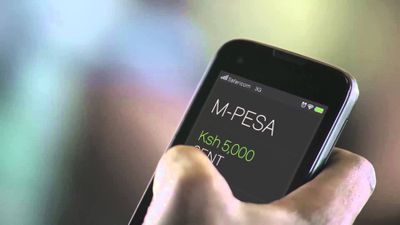
Where central banks built shared rails early, competition tends to be broad. Nigeria's NIBSS Instant Payment system has connected banks for more than a decade, which is one reason Nigerian fintech is crowded and fiercely competitive. Ghana mandated mobile money interoperability in 2018. Where one wallet was allowed to reach scale first, as with M-Pesa in Kenya or Wave and Orange Money in francophone West Africa, interoperability stops being a technical project and becomes a negotiation with the incumbent.
The WAEMU is running that negotiation in public, across eight countries and one currency. Mali, Burkina Faso and Niger have left ECOWAS but remain inside the monetary union and on the same rail. Whatever the BCEAO does tomorrow will be read as a precedent by every central bank on the continent weighing whether to force open a dominant wallet.
What to take from this
For regulators: a public rail is only as strong as the deadline behind it. The PI-SPI experience suggests that interoperability works best when the rules are set before any single private network becomes too big to compel. It also suggests that a regulator who moves deadlines teaches the market to wait.
For founders: if the rail wins, the moat moves. Holding the customer's balance will matter less. Credit, merchant tools, data and business services built on an open rail will matter more. Fintechs in the region, and in markets watching it, should plan for a world where payments themselves are a free utility.
For investors: WAEMU equity risk is regulatory risk, and it is currently being priced as unpriceable. A clean outcome tomorrow, in either direction, may be worth more to the region's startup ecosystem than any single funding round. It would give equity investors a rulebook they can underwrite.
The quietest deadline in African fintech this year might turn out to be the one that decides who writes the rules for the next decade.