It was in Kigali, on the sidelines of the Deep Learning Indaba, that AfriClimate AI unveiled Forecast4Africa. The setting could not have been more symbolic. The Indaba has become the heartbeat of Africa’s machine learning community, and in the same space, AfriClimate AI introduced a project that could reshape how Africa understands its skies, seasons, and future.
iAfrikan present at the launch, sat in that room, surrounded by researchers, policymakers, and community builders. It struck us, that not only was there a strong technical ambition but also the sense of urgency and possibility. Africa, after all, carries the heaviest burden of climate change impacts while being the most under-served when it comes to climate data.
The depth of the challenge
Consider this, Africa has just 37 weather radar stations to cover more than 1.4 billion people, while the United States and the European Union together maintain over 600. In Ghana, rainfall station coverage has collapsed from 518 in the 1970s to fewer than 100 today. Across the continent, the average density of observation stations is only one-eighth of what the World Meteorological Organization recommends.
These aren’t just abstract numbers. Each missing weather station translates into a missing piece of information, a blind spot in a farmer’s decision about when to sow, a disaster manager’s warning system, or an energy operator’s forecast of hydropower supply. Without data, decisions are reduced to guesswork.
A new proposition
Forecast4Africa is AfriClimate AI’s answer to this gap: deploy networks of automatic weather stations, fuse them with satellite and reanalysis data, and apply state-of-the-art machine learning to produce medium-range forecasts fine-tuned to African realities. But the promise of the project is not only technical; it is deeply social.
As Rendani Mbuvha, Director and co-founder of AfriClimate AI, said during the launch:
“Climate change is making rainfall patterns more unpredictable, and without accurate forecasts, planning becomes a risky guess. Forecast4Africa aims to change that.”
This is not the language of abstract modeling. It is the language of livelihoods, of maize fields in Limpopo, cassava plots in Ghana, and fishing communities on Lake Victoria.
People, partners, and ecosystems
The strength of Forecast4Africa lies in its insistence that forecasts must be built with and for communities, in partnership with local institutions. At the launch, Amal Nammouchi, co-founder of AfriClimate AI, made this clear:
“Forecast4Africa is not just about models or data; it’s about people: the farmers, energy operators, disaster managers who need forecasts that see their land, their sky, their soil.”
But communities alone cannot shoulder the work. Ecosystem partners are critical in bridging research, policy, and practice. Institutions like iLabAfrica at Strathmore University are stepping in to ensure scientific robustness and local usability.
As Dr Betsy Murithi-Chieng of iLabAfrica explained:
“Having local sensor networks gives us data we can believe in , data close to farms, hills, rivers. But equally important is ensuring those forecasts are in local languages and formats people use. That’s what will make them trusted, used, and ultimately life-saving.”
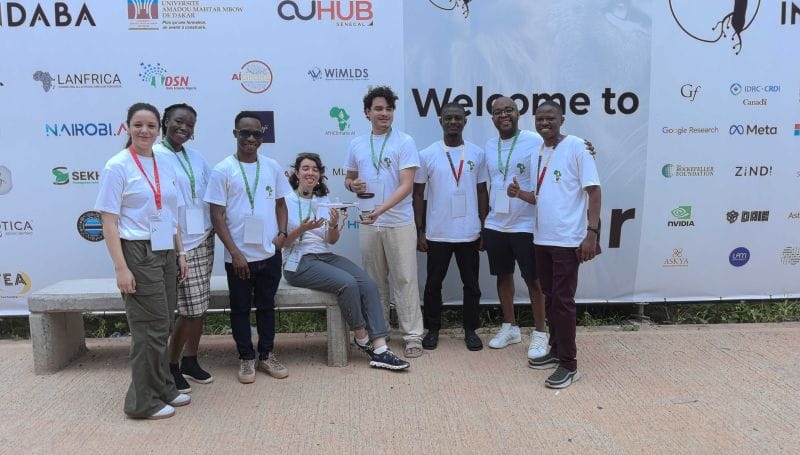
Forecast4Africa Launch at the Digital Transformation Center Rwanda in Kigali
Leaving the launch, I found myself reflecting on how history might remember this moment. If Forecast4Africa succeeds, it may be remembered as the pivot where Africa ceased being the blind spot in global climate forecasting and became a leader in climate intelligence.
There is, of course, a long road ahead, station deployments to manage, models to refine, communities to engage, and policymakers to convince. But the spark has been lit. And in Kigali, I saw not just the announcement of a project, but the opening of a chapter ,one where Africa begins to see its own skies clearly, and in doing so, secures its own climate future