On 3 September, Kenya's High Court struck at the heart of the country's attempt to regulate ride-hailing. Justice Roselyne Aburili ruled against the 2022 digital taxi regulations, including their 18% cap on the commission platforms such as Uber and Bolt can take from drivers. The government, she found, had not produced enough evidence that the cap was necessary or proportionate. It had carried out no regulatory impact assessment, and the rules had been gazetted during a parliamentary recess without proper legislative scrutiny. The court also found that the regulation's data retention requirements amounted to "a regime of continuous surveillance," breaching the constitutional right to privacy and the Data Protection Act.
Crucially, the court suspended its declaration of invalidity for 12 months. The cap and the driver safety and verification rules stay in force while the government redoes the work properly, with fresh public participation and an impact assessment. Meanwhile, the Competition Authority of Kenya is positioning itself as the gig economy's main enforcer, armed with a proposed Competition (Amendment) Bill 2026 aimed at platforms commission structures and algorithmic management of drivers.
The drivers are not the only Kenyan tech workers the state is trying to protect. In July, Kenya's ICT Ministry moved to set occupational guidelines for the data annotators and content moderators who have made Nairobi a global hub for "AI supply chain" work. These workers have reported pay of roughly $1.46 to $3.74 an hour, compared with an average of $21 to $27 for moderators in the United States. They review material including "graphic violence, self-harm, child abuse and rape." The guidelines call for fair-pay benchmarks calibrated against international rates, mental health care, psychosocial support, grievance mechanisms, transparent contracting and compliance reporting on pay. The legal cases brought by former Meta content moderators, including Daniel Motaung and a group of 184 moderators, remain unresolved after rulings due in February were postponed.
Kenya's instinct is clear. It sees platform workers as workers, with rights to fair pay, safe conditions and privacy, and it is willing to regulate foreign platforms to deliver that. The court ruling doesn't reject that instinct. It tells the state to do it with evidence. The risk is equally clear. Every new obligation raises the cost of Kenya compared with competing locations, in a market where clients can move work to another time zone with a contract change.
Cairo's export model
Egypt has made the opposite bet. It treats the same kind of workers as an export industry.
The Information Technology Industry Development Agency (ITIDA) now puts digital freelancers at the centre of Egypt's offshoring strategy. By ITIDA's count there are around 850,000 of them, and the World Bank ranks Egypt ninth in the world for freelancing. Egypt earned $5.2 billion from digital services offshoring in 2025 and is targeting $6 billion in 2026. With nearly 750,000 university graduates a year, around 50,000 of them engineers, the pipeline is enormous. ITIDA runs programmes such as Egypt FWD and ITIDA Gigs and has said new incentive packages for freelancers are coming. "The expansion of freelancing is contributing directly to digital exports and strengthening Egypt's integration into global services markets," said Mahmoud Sofrata, ITIDA's vice president for market development, in June. The Finance Ministry's first VAT guide for digital services, issued last December, was also read by the local tech press as treating remote tech-talent exports as outside the VAT net.
The logic is macroeconomic. A country short of foreign currency sees a young, multilingual workforce earning in dollars and euros as a balance-of-payments strategy. The language is of revenue targets, rankings and incentives. Pay floors and mental health care barely come up. That doesn't make Egypt indifferent to workers. It means the state's first question is how many people it can connect to foreign demand, not what terms they work on.
Casablanca & Durban's pipeline model
Morocco and South Africa have gone a third way. They build the pipeline themselves and treat outsourcing as an industrial sector with jobs targets.
Morocco's offshoring sector employed about 148,500 people by the end of 2024 and exported 26.22 billion dirhams of services. Under the Digital Morocco 2030 strategy and a dedicated 2024–2030 programme contract, the government wants 130,000 more jobs, taking the sector to around 270,000, and export revenues of around 40 billion dirhams by 2030. It is steering investment towards five priority segments: IT outsourcing, customer relations, business process, engineering and knowledge process outsourcing.
South Africa's Global Business Services Masterplan, launched in 2022 by the Department of Trade, Industry and Competition, the industry body BPESA and the Harambee Youth Employment Accelerator, targets 500,000 cumulative jobs serving international clients by 2030. In 2025 the sector created 26,346 international jobs, the most since 2018, and around 90% of them went to young people. In July, BPESA and Harambee launched an Impact Sourcing Practical Guide to push employers to hire from communities that traditional recruitment ignores. South Africa is now regularly ranked among the world's most attractive offshoring destinations.
This model is the least glamorous and arguably the most deliberate. It pairs state targets with employer commitments and a youth employment intermediary, and it measures success in jobs created for young people.
Lagos, a model that isn't
Then there is the largest tech talent pool on the continent, with the least explicit policy.
Nigeria's engineers are in heavy global demand. Remote developers in Nigeria reportedly expect salaries in the tens of thousands of dollars a year from foreign employers, and platforms such as Andela have placed large numbers of Nigerian engineers into global teams. With the naira having lost roughly half its value against the dollar since early 2024, a Lagos engineer paid in dollars can earn many times a local salary while paying Lagos prices. That is why "remote" has become the alternative to japa, the Nigerian slang for emigrating
The state has not really chosen a model. It has national talent programmes, but no equivalent of Kenya's protections, Egypt's export targets or South Africa's jobs masterplan for the Nigerians already working for foreign firms. The market has simply organised itself. For the individual engineer, this often works brilliantly. For the country, it means a significant export sector that its own statistics barely capture and its policy barely shapes.
Connecting the Dots
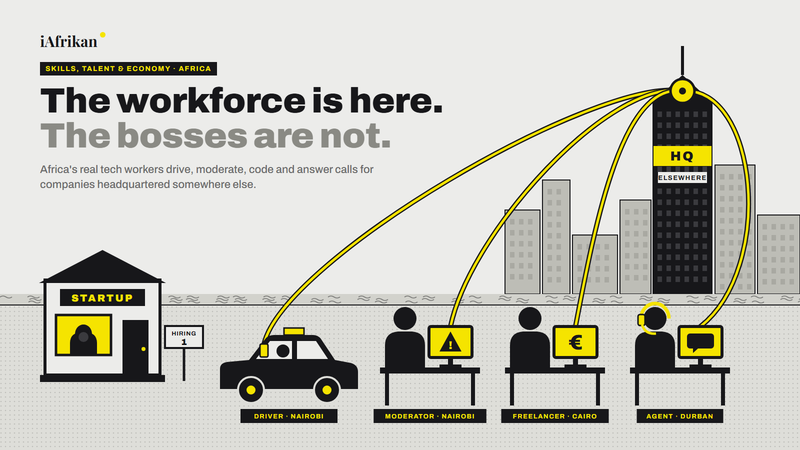
For years, Africa's tech skills conversation has been framed as a pipeline problem. Train enough coders, data scientists and engineers, the argument goes, and local tech companies will absorb them and grow. That picture misses where most tech-linked work on the continent actually happens.
The scale of the employment problem makes the point sharper. The World Bank estimates that 10 to 12 million young Africans enter the labour force each year, against about 3 million new formal jobs. No plausible number of African startups will close that gap on their own. Platform work, outsourcing and remote export services already employ hundreds of thousands of people and could employ millions. They are the continent's largest realistic source of tech-linked jobs this decade.
That changes what "skills policy" should mean. It is not only about bootcamps and computer science degrees. It is about the terms on which Africans plug into global digital work. What they are paid, what protections they have, how their earnings are taxed and counted, and whether the work builds skills that lead somewhere better. It is also, increasingly, about the fact that some of this work, especially customer service and data labelling, is precisely the work generative AI is being built to automate. A country whose talent strategy is "more call-centre seats" needs a plan for what those workers do next.