Two things happened to satellite internet users in Africa last week. They point in opposite directions.
On 22 October, in Zirobwe, a farming town north of Kampala, MTN Uganda chief executive Sylvia Mulinge cut a ribbon at Libra International School to launch MTN Starlink for Business. The school was the showcase customer for a service that brings Starlink's satellites to Ugandan schools, clinics and businesses under MTN's name.
A day later, in South Africa, people who had been quietly running imported Starlink dishes started getting notices from the company. Starlink holds no license in the country and has never officially launched there. To keep their service, they would have to register as travellers.
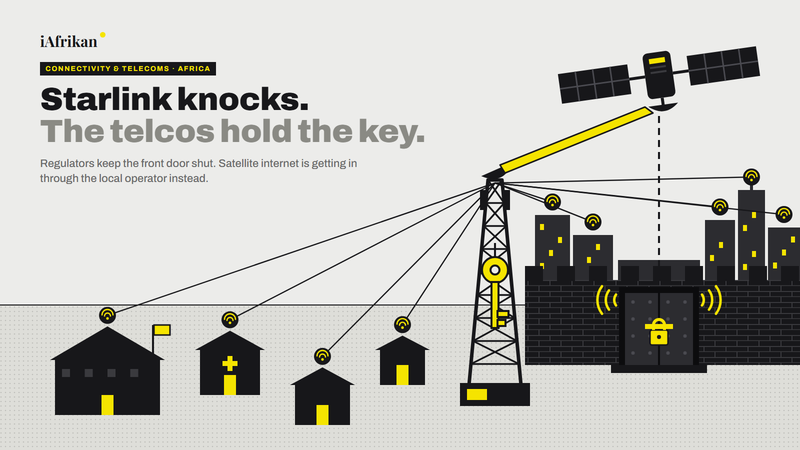
That is the same satellite network, in the same week, on the same continent. In one country it is cutting ribbons with the biggest local telco. In the other it is treating its own users as tourists. The difference comes down to one decision, whose name is on the license.
Two doors
A satellite company can enter an African market in one of two ways.
The first is the front door. The satellite company applies for a license in its own name, sells directly to customers and competes with the local telcos. That is the model Starlink has preferred almost everywhere. It works where the government wants competition more than control. Where ownership rules or a strong incumbent stand in the way, it is now failing in public.
The second is the side door. A company that already holds a local license carries the satellite service under its own brand. That might be a mobile operator, an internet provider or a reseller. The satellite company supplies capacity and the local partner owns the customer. Local ownership rules are met by default, because the licensee is already local.
Through 2026, almost every new satellite entry that worked used the side door. Almost every one that stalled tried the front door.
The scorecard
South Africa: front door shut, side door open.
Starlink still has no license from ICASA. By June 2026 it had not even applied for spectrum or a network licence, according to a parliamentary answer. The barrier is the Electronic Communications Act's requirement that licensees be at least 30% owned by historically disadvantaged groups. In June 2025, SpaceX offered an alternative, an equity-equivalent investment package worth about R500 million, including free internet for more than 5,000 rural schools. In May 2026, ICASA said it cannot recognise that kind of arrangement until Parliament amends the Act.
Meanwhile, Amazon walked in the side door. On 15 July, Amazon Leo signed a deal with Herotel, a South African internet provider. Herotel will sell the service under its own brand, Evry, and handle installation, sales and support. Herotel holds the licences and Amazon supplies the network. Amazon is not applying for its own South African licence, so the ownership question that has stalled Starlink for three years does not come up. Commercial service is expected in 2027.
Senegal: front door opened, then a court shut it.
Senegal licensed Starlink directly. A ministerial order dated 6 November 2025 authorised Starlink Sénégal to provide fixed satellite internet for five renewable years, and the service launched in February 2026. Sonatel, the Orange-controlled incumbent, objected to the terms of Starlink's entry. Its appeal to the ministry in March failed, so it went to the Supreme Court. On 7 September, the court provisionally suspended Starlink's licence while it hears the full case.
Senegal matters because it shows the front door can close even after it has opened. A license granted in a minister's office can still be challenged in court by an incumbent with standing, deep pockets and a national-champion story.
Uganda: front door with conditions, then the side door.
Uganda licensed Starlink on 15 May 2026, with strict conditions, a local physical presence, a national gateway, and registration of every terminal in the country. Paratus Uganda became the first company to sell the service commercially on 24 August. Three days later, MTN Uganda announced it would become an authorised reseller, and last week's launch in Zirobwe followed. MTN's offer focuses on enterprise customers, schools, healthcare, agriculture, humanitarian work and government. Those are the customers where a telco relationship carries the most weight.
DR Congo: the side door goes straight to your phone.
The DRC gave Starlink a full license in May 2025. The most important thing to happen there this year, though, without a dish. On 14 August, Airtel Congo switched on Starlink Mobile, the first commercial satellite-to-phone service in Africa. It works on ordinary LTE Android phones, with no dish and no special handset. Where no mast reaches, the phone connects to a satellite instead.
For now, the service is basic. It carries SMS and light data such as WhatsApp messages, has no voice calls, and runs at under 1 Mbps. Customers need an active data bundle. Airtel signed the underlying agreement with SpaceX in December 2025 and plans to roll it out across all 14 of its African markets by the end of 2026. It has already tested the service in Kenya, Uganda and Madagascar.
Kenya: the door is being rebuilt.
Kenya let Starlink in through the front door in 2023 and became one of its most visible African markets. Now the Communications Authority (CA) has published a draft Satellite Frequency Licensing Framework, 2026, and asked the public whether its requirements are "clear and proportionate". Meanwhile, Airtel Kenya's satellite-to-phone service is waiting on the CA's approval before it can sell what Congolese customers can already buy.
Why satellite-to-phone tips the balance
A home satellite dish is a product a satellite company can sell on its own. Satellite-to-phone service is not.
Satellite-to-phone service reaches the phone already in your pocket. That means it relies on the mobile operator, its SIM, its customer relationship and, typically, its licensed mobile spectrum. A satellite company cannot offer it to an African mobile user without a mobile operator as a partner. Through the front door, it would be selling to nobody.
GSMA Intelligence's satellite tracker for the third quarter of 2026 shows how early Africa is. Only 13% of sub-Saharan mobile operators have any satellite partnership, against a global average of 19%. Its researchers expect broad satellite-to-phone coverage, including across much of Africa, around 2028 or 2029. In other words, the partnerships that will decide who controls satellite-to-phone service in Africa are being signed right now, mostly with operators who have only just started.
The threat became a product
For three years, African telcos treated low-orbit satellite as a threat. They lobbied for a level playing field and argued that satellite providers compete for the same customers without carrying the same obligations. Sonatel went to court. In South Africa, the incumbents' position lined up conveniently with the ownership rules.
That threat is now becoming something telcos sell. MTN resells Starlink in Uganda. Airtel sells Starlink Mobile in the DRC and plans to sell it everywhere else it operates. Herotel turned Amazon's satellites into its own brand. The operators that fought satellite are positioning themselves as the companies satellite has to go through.
For the incumbents, this is good business. For everyone else, there is a catch nobody is discussing. Part of the original promise of low-orbit satellite internet in Africa was price discipline. A new supplier, independent of the local telcos, would force them to cut prices or improve service. When satellite arrives as a product of those same telcos, that pressure disappears. The satellite is still there, but the competition is gone.
None of this makes the side door a bad door. Local licensees meet local ownership, tax and lawful-interception rules more easily. They already have shops, agents and billing systems. For a school in Zirobwe, buying from MTN may simply be the easiest way to get online. The question is not whether the side door should exist. It is whether it should be the only door, and whether one operator can lock it behind itself.
What regulators should be writing down now
Kenya's consultation is the first in a major market since satellite-to-phone service went commercial in Africa. That makes it the first chance to write rules for the side door, not only the front. A framework fit for the next five years would answer at least these questions:
- Exclusivity: Can a satellite operator sign an exclusive satellite-to-phone deal with one mobile operator in a market? If so, customers of every other network are locked out of satellite coverage for their own phones.
- Wholesale access: If a mobile operator brings satellite capacity into the country, must it offer that capacity to smaller internet providers and community networks on reasonable terms?
- Pricing transparency: Must satellite services sold by an operator be priced and advertised separately from ordinary bundles, so customers can see what the satellite actually costs?
- Emergency access: Should every compatible phone be able to send an emergency message by satellite, whatever its network? Several countries outside Africa already treat this as a public-safety question.
- Equal obligations: If a satellite company sells directly, through the front door, does it carry the same coverage, consumer-protection and data obligations as a local licensee? Otherwise the rules quietly push everyone towards the side door.
The Communications Authority of Kenya is taking comments on the draft Satellite Frequency Licensing Framework, 2026, until 6 November 2026. Submissions must use the CA's prescribed template, published with the consultation paper on the CA website, and go to frequencyreturns@ca.go.ke.
You do not need to be a telco to respond. Rural schools, clinics, county governments, community networks, humanitarian agencies and small internet providers are the users the side door will serve or shut out. The Kenyan rules will also be read closely in Kampala, Kinshasa, Dakar and Pretoria.
Africa spent three years arguing about whether to let a satellite company in. The question for the next three years is who holds the key.